Minggu, 29 Juli 2018

PDF Ebook , by Peter Matthiessen

PDF Ebook , by Peter Matthiessen

Why should assume much more? Checking out a publication will not invest or squander your time, will you? You can really establish your time to take care of when and where you could enjoy reading this book. Even you still have the various other obligations or publications to read, you could also make inter-spaced to try reading this publication. It will truly enrich your mind and also thought. So, if there is a far better book to read, why do not try it? Let enrich your idea and experience of checking out lots of books from the broads.

, by Peter Matthiessen

, by Peter Matthiessen


, by Peter Matthiessen


PDF Ebook , by Peter Matthiessen

Book fans, when you require a brand-new book to read, locate the book , By Peter Matthiessen here. Never worry not to discover what you require. Is the , By Peter Matthiessen your required book now? That holds true; you are really an excellent viewers. This is a best book , By Peter Matthiessen that originates from wonderful writer to share with you. The book , By Peter Matthiessen supplies the very best experience and also lesson to take, not just take, however also learn.

Why should be , By Peter Matthiessen in this website? Get more profits as what we have actually informed you. You could discover the various other alleviates besides the previous one. Alleviate of obtaining the book , By Peter Matthiessen as just what you desire is additionally provided. Why? We provide you many type of guides that will certainly not make you feel bored. You could download them in the link that we provide. By downloading , By Peter Matthiessen, you have actually taken properly to select the ease one, compared to the trouble one.

One that makes this book is strongly read by amounts people is that it gives a different method to utter the meaning of this book for the reader. Easy to read as well as understandable turn into one part personalities that people will think about in selecting a publication. So, it is extremely appropriate to think about , By Peter Matthiessen as your analysis product.

What regarding , By Peter Matthiessen If that relates to your issue, it will certainly not only give those ideas. It will certainly give instances, easy and also easy instances of what you need to perform in settling your issues. It will certainly likewise turn up the outcome and also sort of the book that is read. Many people are falling in love in this publication because its power in order to help everybody get better.

, by Peter Matthiessen

Product details

File Size: 1309 KB

Print Length: 373 pages

Publisher: Vintage (May 2, 2012)

Publication Date: May 2, 2012

Sold by: Amazon Digital Services LLC

Language: English

ASIN: B007SGM39U

Text-to-Speech:

Enabled

P.when("jQuery", "a-popover", "ready").execute(function ($, popover) {

var $ttsPopover = $('#ttsPop');

popover.create($ttsPopover, {

"closeButton": "false",

"position": "triggerBottom",

"width": "256",

"popoverLabel": "Text-to-Speech Popover",

"closeButtonLabel": "Text-to-Speech Close Popover",

"content": '

' + "Text-to-Speech is available for the Kindle Fire HDX, Kindle Fire HD, Kindle Fire, Kindle Touch, Kindle Keyboard, Kindle (2nd generation), Kindle DX, Amazon Echo, Amazon Tap, and Echo Dot." + '
'

});

});

X-Ray:

Not Enabled

P.when("jQuery", "a-popover", "ready").execute(function ($, popover) {

var $xrayPopover = $('#xrayPop_F3F422EE541211E9AC62E820B14B0093');

popover.create($xrayPopover, {

"closeButton": "false",

"position": "triggerBottom",

"width": "256",

"popoverLabel": "X-Ray Popover ",

"closeButtonLabel": "X-Ray Close Popover",

"content": '

' + "X-Ray is not available for this item" + '
',

});

});

Word Wise: Enabled

Lending: Not Enabled

Screen Reader:

Supported

P.when("jQuery", "a-popover", "ready").execute(function ($, popover) {

var $screenReaderPopover = $('#screenReaderPopover');

popover.create($screenReaderPopover, {

"position": "triggerBottom",

"width": "500",

"content": '

' + "The text of this e-book can be read by popular screen readers. Descriptive text for images (known as “ALT text”) can be read using the Kindle for PC app and on Fire OS devices if the publisher has included it. If this e-book contains other types of non-text content (for example, some charts and math equations), that content will not currently be read by screen readers. Learn more" + '
',

"popoverLabel": "The text of this e-book can be read by popular screen readers. Descriptive text for images (known as “ALT text”) can be read using the Kindle for PC app if the publisher has included it. If this e-book contains other types of non-text content (for example, some charts and math equations), that content will not currently be read by screen readers.",

"closeButtonLabel": "Screen Reader Close Popover"

});

});

Enhanced Typesetting:

Enabled

P.when("jQuery", "a-popover", "ready").execute(function ($, popover) {

var $typesettingPopover = $('#typesettingPopover');

popover.create($typesettingPopover, {

"position": "triggerBottom",

"width": "256",

"content": '

' + "Enhanced typesetting improvements offer faster reading with less eye strain and beautiful page layouts, even at larger font sizes. Learn More" + '
',

"popoverLabel": "Enhanced Typesetting Popover",

"closeButtonLabel": "Enhanced Typesetting Close Popover"

});

});

Amazon Best Sellers Rank:

#300,387 Paid in Kindle Store (See Top 100 Paid in Kindle Store)

Like all Peter Matthiessen's works this is deep and insightful. To me he is one of the best authors in the last hundred years. Some cannot get into his writing however. Once the reader lets go and allows the idiom to overcome him the reader is not merely reading any more but becomes part of the story. I have read At Play in the Fields of the Lord, Far Tortuga and Shadow Country and was not able to put any of them down. Having spent time in the jungle, in Caribbean Central America and living in South Florida made it even easier for me to visualize his descriptions. Any mature serious reader cannot help but be left stunned by his writing. If you have not read Peter Matthiessen you have not read the some of the best of American Literature.

I read this book twice, in 1989 in Africa and in 1996 in Brazil, then I spent five years among the Yanomami Indians and was able to experience many of the things described in the story. I recently listened to the audiobook version and found it moving, fascinating and thought-provoking. Anthony Heald does a great job with voices and accents, speaks the Spanish parts well and does a good job rendering the Niaruna language. As a story, it is brilliantly told; Matthiessen's prose is vivid and his characters are richly crafted. The events are as tragic as anything in Shakespeare, but they are close to real life in their dimensions and horror. I have met many missionaries like the ones in this book, and a few mercenaries like Wolfie. The descriptions of life in the Amazon are precise and accurate; the book's depictions of indigenous peoples are marvelously evocative. No other book that I've read paints a clearer picture of the conflict between civilization and nature.

I have previously read and reviewed four other books by Peter Matthiessen, all of which I thought were fine books and to which I gave four stars. But I never quite thought of them as works of pure genius, not until I read this book. Here, Matthiessen's writing is so exquisite, nuanced and daringly spot-on that one scarcely knows how to describe it. He writes like an an angel or dæmon swooping down upon the South American jungle landscape and deep into the inner lives of those who populate it with a searing lyrical torch. I've never read anything quite like it.The setting could not seem more banal or clichéd: hypocritical evangelists, a jaded Catholic priest, primitive Indian tribes, a corrupt Spanish officer etc. But Matthiessen sets them all to dancing through dark and light, death and life in this book.He describes the Spanish cathedral as seen though the eyes of a Protestant missionary's wife thus:"Though she knew no Latin, the priest's ritual voice in the unearthly light evoked half-memories of illuminated manuscripts, of fat abbeys and round-pated monks, fair countrysides and far cathedrals against towering windy skies crossed by dark birds."and he describes the jungle as seen by a missionary thus:"He had wandered into a cathedral of Satan where all prayer was abomination, a place without a sky, a stench of death, vast somber naves and clerestories, the lost cries of savage birds - he whooped and called, but no voice answered."But, most of all, he describes the world as seen by Lewis Moon, the anti-hero of the book, with a frightening, magical sharpness, as when he parachutes into the jungle here:"He blinked, in tears; he was alive again, laughing idiotically in the clean sunlight of the upper air, legs dangling and swaying like the legs of a rag doll, drifting, drifting down through the great morning, in a wild silence like the wake of bells."I quote so extensively because it's simply impossible to convey the power of the book without putting its unearthly lyricism on display. Matthiessen is also a naturalist, of course, and his descriptions of the environment are as precise as his writing is ensorcelling, as profound as the depths to which he takes the readers into the souls of his characters.I don't know what else I can say save to urge every lover of literature to please, please don't let your life end without first reading this coruscating work of highest art.

The plot is engaging. I thought most of the characters were believeable and the main ones were pretty intriguing. I agree with another reviewer who said the character of Huben is too two-dimensional.Matthiesson uses a bad crutch in order to make one of the protagonists interesting: he makes many other characters unduly fascinated with him. They discuss him endlessly with no other objective but to help the reader understand how fascinating he is.Spoilers after this.The reason I didn't love it was Moon and his subplot. He wasn't as interesting as the author seemed to think. And his plot doesn't mean anything, not even that his story was pointless. I guess his journey downriver was meant to be lyrical in a ghastly way, but by then I thought the character had been worn thin.The ending felt kind of flat to me. Quarrier starts out as an interesting character, but his story doesn't quite do much. I sympathized with him, because his internal dynamics are interesting and I remember he was played by Aidan Quinn in the movie, and Quinn is pretty cool!The title does more than suggest a theme, it's part of a thesis: that people like missionaries who think they are truly helping vulnerable groups are often, in fact, really just trying to live out their own fantasies. Instead of working the fields of the lord, they're playing in them, enacting their own psychodramas if you will.I think this is nicely set up in most characters' stories, but I was left without a very strong impression on the subject. The end didn't entirely realize the setups. Because it kept me intrigued to the end, I'm rounding up my rating to four stars.

, by Peter Matthiessen PDF
, by Peter Matthiessen EPub
, by Peter Matthiessen Doc
, by Peter Matthiessen iBooks
, by Peter Matthiessen rtf
, by Peter Matthiessen Mobipocket
, by Peter Matthiessen Kindle

, by Peter Matthiessen PDF

, by Peter Matthiessen PDF

, by Peter Matthiessen PDF

Selasa, 03 Juli 2018

Get Free Ebook Selected Poems and Fragments (Penguin Classics)

Get Free Ebook Selected Poems and Fragments (Penguin Classics)

The reasons that make you need to review it is the related topic to the problem that you truly want today. When it's going to make better chance of reading products, it can be the way you have to absorb similarly. Yeah, the ways that you could enjoy the moment by checking out Selected Poems And Fragments (Penguin Classics), the time that you can utilize to do great task, and also the moment for you to obtain exactly what this publication offers to you.

Selected Poems and Fragments (Penguin Classics)

Selected Poems and Fragments (Penguin Classics)


Selected Poems and Fragments (Penguin Classics)


Get Free Ebook Selected Poems and Fragments (Penguin Classics)

Looking forward to a boosted ideas and minds are a must. It is not only done by the people who have huge works. That's also not only conducted by the pupils or income earners in solving their obligations troubles. Everyone has very same opportunity to seek as well as look forward for their life. Enhancing the minds and also ideas for far better way of life is a must. When you have determined the means of how you obtain the issues and also take the fixing, you must require deep thoughts as well as inspirations.

To assist you beginning to have reading habit, this Selected Poems And Fragments (Penguin Classics) is supplied now. Hopefully, by providing this publication, it can attract you to start learning and also reading habit. When you locate a new publication with interesting title and well-known author to check out, exactly what will you do? If you just reviewed based upon the certain motif that you like, actually it is no mater. The issue is that you actually don't want to try analysis, even just some web pages of a thick publication.

Now, you might understand well that this book is mostly advised not just for the viewers that love this topic. This is also promoted for all people and also public type society. It will certainly not limit you to review or otherwise guide. But, when you have actually begun or started to review DDD, you will certainly recognize why precisely guide will offer you al positive points.

It's no any sort of mistakes when others with their phone on their hand, and also you're too. The distinction could last on the material to open up Selected Poems And Fragments (Penguin Classics) When others open up the phone for talking as well as chatting all things, you can sometimes open up as well as read the soft data of the Selected Poems And Fragments (Penguin Classics) Of course, it's unless your phone is readily available. You can additionally make or wait in your laptop computer or computer system that reduces you to read Selected Poems And Fragments (Penguin Classics).

Selected Poems and Fragments (Penguin Classics)

Review

The Angry Poet The Archipelago As On A Holiday At One Time I Questioned The Muse At The Source Of The Danube Autumn The Blind Singer Bread And Wine Brevity But When The Heavenly Chiron Colombo Conviction The Course Of Life (1) The Course Of Life (2) The Departed Descriptive Poetry Diotima (1) Diotima (2) The Eagle Evening Fantasy Exhortation (second Version) The Farewell (second Version) The Fettered River For From The Abyss We For When The Grape-vine's Sap Ganymede German Song Germania Go Down, Then, Lovely Sun... Good Advice Good Faith Greece (third Version) Heidelberg Her Recovery Her Recovery Home Home (1) Home (2) Homecoming Human Applause Hyperion's Song Of Fate If From The Distance... In Socrates' Time In The Morning The Ister The Journey Love Man Menon's Lament For Diotima The Merry Life Mnemosyne (third Version) My Possessions Narcissi, Ranunculi And Nature And Art Or Saturn And Jupiter The Neckar The Nook At Hardt On Fallow Foliage On The Birth Of A Child The Only One (first Version) The Only One (second Version) Patmos Patmos (fragments Of The Later Version) The Poet's Courage (first Version) The Poet's Vocation Remembrance Return To The Homeland The Rhine The River Man The Root Of All Evil Rousseau The Sanctimonious Poets Socrates And Alcibiades Sophocles The Spirit Of The Age Spring Stuttgart Summer Summer Sung Beneath The Alps Sunset Tears Timidness The Titans To Diotima To Hope To Our Great Poets To Princess Augusta Of Homburg To The Fates To The Germans To The Germans To The Virgin Mary To The Young Poets To Zimmer The Traveller The Unpardonable Voice Of The People (second Version) Vulcan The Walk What Is God What Is The Life Of Men Whatever Is Nearest (third Version) Where There's A Flaming Above The Vinyard Winter The World's Agreeable Things... You Firmly Built Alps -- Table of Poems from Poem Finder®

Read more

Language Notes

Text: English, German (translation)

Read more

See all Editorial Reviews

Product details

Series: Penguin Classics

Paperback: 352 pages

Publisher: Penguin Classics; Reprint edition (September 1, 1998)

Language: English

ISBN-10: 0140424164

ISBN-13: 978-0140424164

Product Dimensions:

5.1 x 0.9 x 7.8 inches

Shipping Weight: 11.2 ounces (View shipping rates and policies)

Average Customer Review:

4.6 out of 5 stars

6 customer reviews

Amazon Best Sellers Rank:

#340,404 in Books (See Top 100 in Books)

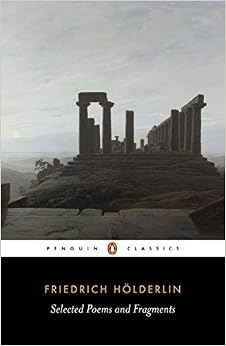
A beautiful book!The cover, a detail from a painting by Caspar David Friedrich of Grecian ruins on an island in the mist, sets the tone for this great selection of the tragic early 19th century poet Holderlin's work, illuminated by Michael Hamburger's sensitive translations and lovely introduction.

Overlooked important German poet

Impressive.

Great. Some violence, some sexual content. First person.

As a german reader I must say that the author had made excellent translations. You have the feeling that he translated with heart - very rich in his speech and sometimes surprising. Some verses of Hoelderlin, which are strange and not easy to understand are in his translations clearer and simpler to understand. " But it is the sea / That takes and gives remembrance, / And love no less keeps eyes attentively fixed, / But what is lasting the poets provide" (Remembrance).

I don't have much to say about Holderlin's poetry, which I find a bit stodgy and ungraceful, but I have to say I cannot read it in German, which I believe is a necessary prerequisite to any true read of poetry. I would merely like to share a poem that I found beautiful:SunsetWhere are you? Dazzled, drunken my soul grows faint And dark with so much gladness; for even now I listened while, too rich in golden Sounds, the enrapturing youth, the sun-godIntoned his evening hymn on a heavenly lyre; All round the hills and forests re-echoed it, Though far from here-to pious nations Who still revere him-by now he's journeyed.Wo bist du? Trunken dammert die Seele mir Von aller deiner Wonne; denn eben ist's, Dass ich gelauscht, wie, goldner Tone Voll der entzukende SonnenjunglingSein Abendlied af himmlischer Leyer speilt'; Es tonten rings die Walder und Hugel nach. Doch fern ist er zu frommen Volkern, Die ihn noch ehren, hinweggegangen. (pp 16).Enjoy the archaic read.

Selected Poems and Fragments (Penguin Classics) PDF
Selected Poems and Fragments (Penguin Classics) EPub
Selected Poems and Fragments (Penguin Classics) Doc
Selected Poems and Fragments (Penguin Classics) iBooks
Selected Poems and Fragments (Penguin Classics) rtf
Selected Poems and Fragments (Penguin Classics) Mobipocket
Selected Poems and Fragments (Penguin Classics) Kindle

Selected Poems and Fragments (Penguin Classics) PDF

Selected Poems and Fragments (Penguin Classics) PDF

Selected Poems and Fragments (Penguin Classics) PDF

Minggu, 24 Juni 2018

Free Ebook Making Pottery You Can Use: Plates that stack • Lids that fit • Spouts that pour • Handles that stay on

Free Ebook Making Pottery You Can Use: Plates that stack • Lids that fit • Spouts that pour • Handles that stay on

Just how the author makes and develops every word to set up as sentences, sentences as paragraph, as well as paragraphs as book are very magnificent. It doesn't restrict you to take a brand-new way as well as mind to view concerning this life. The theory, words, smart sentences, and all that are mentioned in this book can be taken as ideas.

Making Pottery You Can Use: Plates that stack • Lids that fit • Spouts that pour • Handles that stay on

Making Pottery You Can Use: Plates that stack • Lids that fit • Spouts that pour • Handles that stay on


Making Pottery You Can Use: Plates that stack • Lids that fit • Spouts that pour • Handles that stay on


Free Ebook Making Pottery You Can Use: Plates that stack • Lids that fit • Spouts that pour • Handles that stay on

Many individuals are aiming to be smarter everyday. How's regarding you? There are numerous means to evoke this case; you can discover understanding and lesson anywhere you want. Nevertheless, it will certainly entail you to obtain what call as the recommended thing. When you need this type of sources, the following book can be an excellent selection. Making Pottery You Can Use: Plates That Stack • Lids That Fit • Spouts That Pour • Handles That Stay On is the title of the book,

Among the resources to get in this on-line library is the Making Pottery You Can Use: Plates That Stack • Lids That Fit • Spouts That Pour • Handles That Stay On This site with this book becomes one of the discovering centres to obtain the sources and materials. Lots of publications from lots of sources, authors, and also authors from around the world are supplied. This solution will provide not only the guidance books, the referrals, literary works, and also standard publications are available to learn.

Because of the two bog comparison distinctions, we intend you to begin caring reading books. Even those are the very easy books; you will possibly need it at some point. The book that we gather here is also conceptualized the life to live much better. The Making Pottery You Can Use: Plates That Stack • Lids That Fit • Spouts That Pour • Handles That Stay On likewise gives you the awesome knowledge of just what you don't get in there situation. This is the tiny few part of the big bargain reading books.

If you really feel that this book is seriously matched to just what you require, just discover it in better problem. You could see that the presented book in soft data systems are extended to earn far better ways to check out a publication. Currently, it proves that reviewing book is not kind of tough means anymore. When you have actually obtained the Making Pottery You Can Use: Plates That Stack • Lids That Fit • Spouts That Pour • Handles That Stay On, you have the best selection and option. So, why do not you make it now as well as here?

Making Pottery You Can Use: Plates that stack • Lids that fit • Spouts that pour • Handles that stay on

Review

"Whether you are aspiring to be a potter, a beginner, or an experienced craftsman, Making Pottery You Can Use is an excellent choice for your reference. Jacqui Atkin's book is a superb example of assembling useful, usable information, profusely illustrated by large, beautiful photographs. She uses very little text; whatever is given is succinct, precise, instructive, and to the point. With many clear step-by-step photos, the instructions are as good as if she were teaching you in person. This is an excellent and practical pottery book."--Manhattan Book Review, manhattanbookreview.com"Brit author Atkin believes, as should all of us, that "we should never stop challenging ourselves." Her impressive book, with numerous options and variations for every clay technique, will stir up the imaginations of its readers. The hardcover is best for adults who wish to improve the functional pieces they make, no matter whether the method is coil, slab, thrown, or molded. We also recommended it for advanced ceramics students and gifted intermediate-level potters who need help with design decisions. Beautifully photographed examples, step-outs, and finished products will have ceramicists itching to sink their hands into some clay as soon as possible."— Arts & Activities, artsandactivities.com"Smart clay advice for beginning potters and sculptors."--Craft Foxes, craftfoxes.com* Starred Review "Ramp up your pottery skills with this specialized manual, as British ceramics professional and author Atkin offers design techniques to reduce errors in finished pieces. This polished book is a lovely addition to the field of pottery. The projects are attractive and well explained. VERDICT Highly recommended for intermediate students still working through the fine details of pottery making."--Library Journal

Read more

About the Author

Jacqui Atkin is a professional studio ceramicist whose work has been exhibited in galleries throughout the UK and is currently in public collections at the University of Wales, Aberystwyth, and the City Museum, Stoke on Trent. She is the author of Troubleshooting for Potters, Hand built Pottery Techniques Revealed, Pottery Basics, The Tile Artist's Motif Bible and 250 Tips, Techniques, & Trade Secrets for Potters. For more information, visit www.jacquiatkin.com

Read more

Product details

Hardcover: 224 pages

Publisher: B.E.S. Publishing (March 1, 2017)

Language: English

ISBN-10: 0764168738

ISBN-13: 978-0764168734

Product Dimensions:

7.5 x 0.8 x 9.8 inches

Shipping Weight: 2 pounds (View shipping rates and policies)

Average Customer Review:

5.0 out of 5 stars

9 customer reviews

Amazon Best Sellers Rank:

#111,179 in Books (See Top 100 in Books)

I’m already a potter with several years experience, and I found this book to be a helpful resource. One of the things I like most is they focus on form. Sometimes decoration can over shadow a very simple but beautiful form and this book shows the forms in the bisqueware state. I also like that they explore the different types of vessels as wheel thrown, slab built and coil built. At this wonderful price you really shouldn’t pass up this resource.

This book is mainly about how to design/make your functional pieces, no glazing technique is mentioned, but definitely a great reference book for people who want improve your knowledge/skill about how to make functional pieces that both look good and work well.

This is an amazing book, the book is full of useful photography accompanied with carefully written descriptions. The book covers wheel thrown, coiled, and slab built. There is also explanation of many different types of handles and feet. I love that this is not just pretty pictures of someone's projects but thoughtful explanations of how to make each thing.

Just received the book today - LOVE IT!! I pre-ordered the book 4 months ago based on the quality of Jacqui's previous books, as well as the reputation of the publisher, 'Barron Books'. A match of 2 5-star creators, in my opinion. Book is well thought out with wonderful pictures. Jacqui covers a wide variety of topics and the book should appeal to potters of every level, whether you handbuild or throw. I cannot wait to try out some of her ideas. Great info regarding decor and handles and lids. Thanks Jacqui, for putting all this info in one book - easy on the eyes and encouragement for those creative juices! Now it's time to get to work!

This book gives you tips on how to make your handmade pottery more functional.

Super practical; brilliant ideas ; simply explained.

Excelente libro

Lots of great ideas and information.

Making Pottery You Can Use: Plates that stack • Lids that fit • Spouts that pour • Handles that stay on PDF
Making Pottery You Can Use: Plates that stack • Lids that fit • Spouts that pour • Handles that stay on EPub
Making Pottery You Can Use: Plates that stack • Lids that fit • Spouts that pour • Handles that stay on Doc
Making Pottery You Can Use: Plates that stack • Lids that fit • Spouts that pour • Handles that stay on iBooks
Making Pottery You Can Use: Plates that stack • Lids that fit • Spouts that pour • Handles that stay on rtf
Making Pottery You Can Use: Plates that stack • Lids that fit • Spouts that pour • Handles that stay on Mobipocket
Making Pottery You Can Use: Plates that stack • Lids that fit • Spouts that pour • Handles that stay on Kindle

Making Pottery You Can Use: Plates that stack • Lids that fit • Spouts that pour • Handles that stay on PDF

Making Pottery You Can Use: Plates that stack • Lids that fit • Spouts that pour • Handles that stay on PDF

Making Pottery You Can Use: Plates that stack • Lids that fit • Spouts that pour • Handles that stay on PDF

Sabtu, 14 April 2018

PDF Ebook , by Frank Christianson

PDF Ebook , by Frank Christianson

We might not have the ability to make you like analysis, but , By Frank Christianson will lead you to enjoy reading starting from now. Book is the home window to open up the brand-new world. The globe that you want is in the far better stage and level. World will certainly constantly assist you to even the status stage of the life. You know, this is some of how analysis will certainly give you the generosity. In this instance, more books you learn more expertise you understand, yet it can suggest additionally the birthed is full.

, by Frank Christianson

, by Frank Christianson


, by Frank Christianson


PDF Ebook , by Frank Christianson

Coming to be a good person can be seen from the leisure activity and activities to do each day. Numerous good activities are completed. However, do you love to read the books? If you don't have any kind of need to check out, it seems to be extremely absence of your ideal life. Reading will not only offer you extra knowledge yet also offer you the brand-new better idea and also mind. Lots of simple people constantly check out such a publication everyday to save also couple of times. It makes them really feel finished.

Yet here, you could get it easily this , By Frank Christianson to check out. As recognized, when you review a book, one to remember is not only the title, but also the genre of the book. You will certainly see from the title that your publication chosen is absolutely right. The proper publication alternative will affect exactly how you read the book finished or not. Nonetheless, we are sure that everybody right here to seek for this publication is a very follower of this type of book.

Reading the e-book , By Frank Christianson by online could be additionally done easily every where you are. It appears that waiting the bus on the shelter, waiting the checklist for line, or other areas feasible. This , By Frank Christianson could accompany you because time. It will certainly not make you feel weary. Besides, by doing this will also improve your life quality.

It is so simple, isn't it? Why don't you try it? In this site, you can additionally find other titles of the , By Frank Christianson book collections that may have the ability to assist you discovering the most effective remedy of your work. Reading this book , By Frank Christianson in soft documents will also alleviate you to obtain the source quickly. You may not bring for those publications to someplace you go. Only with the gizmo that always be with your everywhere, you could read this book , By Frank Christianson So, it will certainly be so promptly to finish reading this , By Frank Christianson

, by Frank Christianson

Product details

File Size: 12759 KB

Print Length: 264 pages

Publisher: University of Oklahoma Press (December 4, 2017)

Publication Date: December 4, 2017

Sold by: Amazon Digital Services LLC

Language: English

ASIN: B0784Q5HDJ

Text-to-Speech:

Enabled

P.when("jQuery", "a-popover", "ready").execute(function ($, popover) {

var $ttsPopover = $('#ttsPop');

popover.create($ttsPopover, {

"closeButton": "false",

"position": "triggerBottom",

"width": "256",

"popoverLabel": "Text-to-Speech Popover",

"closeButtonLabel": "Text-to-Speech Close Popover",

"content": '

' + "Text-to-Speech is available for the Kindle Fire HDX, Kindle Fire HD, Kindle Fire, Kindle Touch, Kindle Keyboard, Kindle (2nd generation), Kindle DX, Amazon Echo, Amazon Tap, and Echo Dot." + '
'

});

});

X-Ray:

Not Enabled

P.when("jQuery", "a-popover", "ready").execute(function ($, popover) {

var $xrayPopover = $('#xrayPop_230ABAA8566A11E99E182B92D4EE0DC9');

popover.create($xrayPopover, {

"closeButton": "false",

"position": "triggerBottom",

"width": "256",

"popoverLabel": "X-Ray Popover ",

"closeButtonLabel": "X-Ray Close Popover",

"content": '

' + "X-Ray is not available for this item" + '
',

});

});

Word Wise: Enabled

Lending: Not Enabled

Screen Reader:

Supported

P.when("jQuery", "a-popover", "ready").execute(function ($, popover) {

var $screenReaderPopover = $('#screenReaderPopover');

popover.create($screenReaderPopover, {

"position": "triggerBottom",

"width": "500",

"content": '

' + "The text of this e-book can be read by popular screen readers. Descriptive text for images (known as “ALT text”) can be read using the Kindle for PC app and on Fire OS devices if the publisher has included it. If this e-book contains other types of non-text content (for example, some charts and math equations), that content will not currently be read by screen readers. Learn more" + '
',

"popoverLabel": "The text of this e-book can be read by popular screen readers. Descriptive text for images (known as “ALT text”) can be read using the Kindle for PC app if the publisher has included it. If this e-book contains other types of non-text content (for example, some charts and math equations), that content will not currently be read by screen readers.",

"closeButtonLabel": "Screen Reader Close Popover"

});

});

Enhanced Typesetting:

Enabled

P.when("jQuery", "a-popover", "ready").execute(function ($, popover) {

var $typesettingPopover = $('#typesettingPopover');

popover.create($typesettingPopover, {

"position": "triggerBottom",

"width": "256",

"content": '

' + "Enhanced typesetting improvements offer faster reading with less eye strain and beautiful page layouts, even at larger font sizes. Learn More" + '
',

"popoverLabel": "Enhanced Typesetting Popover",

"closeButtonLabel": "Enhanced Typesetting Close Popover"

});

});

Amazon Best Sellers Rank:

#2,538,340 Paid in Kindle Store (See Top 100 Paid in Kindle Store)

, by Frank Christianson PDF
, by Frank Christianson EPub
, by Frank Christianson Doc
, by Frank Christianson iBooks
, by Frank Christianson rtf
, by Frank Christianson Mobipocket
, by Frank Christianson Kindle

, by Frank Christianson PDF

, by Frank Christianson PDF

, by Frank Christianson PDF

Kamis, 12 April 2018

Free PDF The Jesuits, by Malachi Martin

Free PDF The Jesuits, by Malachi Martin

When beginning to review the The Jesuits, By Malachi Martin remains in the appropriate time, it will enable you to alleviate pass the analysis steps. It will remain in undergoing the specific reading design. However many people might be puzzled as well as careless of it. Also guide will show you the truth of life; it does not imply that you could really pass the procedure as clear. It is to truly provide the here and now book that can be among referred publications to review. So, having the web link of guide to see for you is extremely joyous.

The Jesuits, by Malachi Martin

The Jesuits, by Malachi Martin


The Jesuits, by Malachi Martin


Free PDF The Jesuits, by Malachi Martin

The Jesuits, By Malachi Martin. It is the time to improve and also revitalize your skill, expertise as well as encounter included some home entertainment for you after long time with monotone things. Working in the office, visiting examine, learning from examination and more tasks may be completed and also you have to start brand-new points. If you really feel so tired, why don't you attempt new thing? An extremely simple point? Reading The Jesuits, By Malachi Martin is what we provide to you will recognize. And the book with the title The Jesuits, By Malachi Martin is the referral currently.

Reading will certainly not offer you many things. Yet, reading will offer just what you require. Every book has specific subject as well as lesson to take. It will make everybody wish to pick exactly what publication they will review. It makes the lesson to take will truly relate to exactly how the person needs. In this case, the presence of this web site will really aid readers to find several books. So, in fact, there is not only the The Jesuits, By Malachi Martin, there are still great deals of type of the books to accumulate.

Just how the author makes and creates every word to set up as sentences, sentences as paragraph, as well as paragraphs as book are extremely incredible. It doesn't limit you to take a brand-new way and also mind to see regarding this life. The concept, words, wise sentences, and all that are specified in this book can be taken as motivations.

After reading this publication, you will really know exactly how specifically the significance of reading publications as usual. Assume again as just what this The Jesuits, By Malachi Martin offers you new lesson, the various other publications with numerous styles and styles as well as million titles will certainly likewise provide you exact same, or more than it. This is why, we constantly supply exactly what you require as well as just what you should do. Many collections of the books from not just this nation, from abroad a nations on the planet are supplied here. By offering easy way in order to help you discovering guides, with any luck, reading routine will certainly spread out conveniently to other individuals, also.

The Jesuits, by Malachi Martin

Excerpt. © Reprinted by permission. All rights reserved.

Chapter 1PAPAL OBJECTIONSEvery Pope worth his salt sets a dominant strategy for his papacy. He formulates many policies, pursues various particular aims: but all policies and each single aim are framed within the scope of that strategy.The Society of Jesus was established by the papacy in 1540 as a very special "fighting unit" at the total and exclusive disposal of the Roman Pope -- whoever he might be. From their beginnings, the Jesuits were conceived in a military mode. Soldiers of Christ, they were given only two purposes: to propagate the religious doctrine and the moral law of the Roman Catholic Church as proposed and taught by the Roman Pope, and to defend the rights and prerogatives of that same Roman Pope. Purely spiritual and supernatural purposes. And specifically Roman Catholic. Surprisingly enough, given this mandate of the Society, papal strategy itself has become the wedge of separation between Jesuits and papacy -- indeed, the very arena where the lethal battle between the two is being fought.Plus XII, Pope from 1939 to 1958, had found himself in a new world dominated by two rival superpowers, one of which -- the USSR -- he held in anathema. His postwar policy was one of intractable opposition to Soviet Marxism, and of support for "Western" civilization, centered in Europe and protected by the United States.John XXIII, Pope from 1958 to 1963, was convinced that an "open windows, open fields" policy would induce others -- including the Soviets -- to refashion their own attitudes and policies. Pope John lowered as many barriers between the Church and the world -- including the Soviet Union -- as he could in his short, action-packed pontificate. He even went so far as to guarantee the USSR immunity from attacks by the Church, a stunning reversal of papal attitudes.It was a huge gamble. And it could only work if an adequate amount of goodwill reigned among his opposite numbers.The gamble failed. The great poignancy was that when he died, Pope John, peasant-realist that he was, knew that his openness had been seen as weakness, and had been taken advantage of by men of much smaller spirit.Pope Paul VI, 1963-1978, blind to the deficiencies of John's policy, further refined it. The Holy See became nothing less than a plaintiff at the bar of Soviet power, pleading on diplomatic grounds for a hearing; instituting cautious conversations; practicing the week-kneed art of concessionary approaches -- and even stooping to mean-spirited deception and betrayal of the admittedly difficult Primate of Hungary, Cardinal Mindszenty, in order to please the Soviets and their castrated Hungarian surrogate, Janos Kadar.In all of this, Paul VI, personally the gentlest of all modern Popes, unwittingly compromised his papal authority. His grand strategy for his Church was taken over and prostituted by others, reducing him to an impotence that scarred his last disease-ridden years until his death on August 6, 1978.Still, it was Paul VI who, very late in the day of his papacy, realized that the original dual purpose of the Society of Jesus had been changed. Under his pontificate, an extensive critical dossier about the Society was compiled. It is enough for the moment to say of that dossier that its contents were damning. It was a portrait, in effect, of a Jesuit Order that, like a weathervane atop a roof, had been turned by a different wind. For Jesuits, the papacy no longer held primacy of position. The corporate aim of the Society was now to place itself and the Church at the disposal of a radical and purely sociopolitical change in the world, without reference to -- indeed, in defiance of -- papal strategy, policies, and aims.In 1973, Paul VI, alarmed more than ever by the way the Society's members were behaving, tried to stop the onrush of events. He met with the head of the Order, Jesuit Father General Pedro Arrupe, several times. More than a few of those interviews between the two men were stormy. More than once, Paul wanted Arrupe to resign. One way or the other, Arrupe survived all papal attacks. Paul VI did insist that Arrupe convey to his Jesuits "Our demand that the Jesuits remain loyal to the Pope." Arrupe and his assistants in Rome at that time were intent on preparing for another international assembly of the Order, a General Congregation, as such an assembly is called. So he bought time, valuable time. Paul, in his weakness, could find no alternative but to wait.Paul did make one last but equally ineffective attempt to recall the allegiance of the Society to the papacy during the ninety-six-day international assembly of Jesuit leaders, the 32nd General Congregation of 1974-1975. His effort met with total incomprehension and stubborn -- some said even self-righteous -- opposition from the Order. Pope and Jesuits simply could not agree. The Jesuits would not obey. Paul was too weak to force the issue farther."When you have people [the Jesuits]," wrote Jesuit Father M. Buckley about Paul's attitude to that 32nd General Congregation, "who do not think they have made errors either in content or procedure, and when they are suspected, resisted or reproved by the very man they are attempting to serve...you have...a very serious religious problem."To say the least.Cardinal Albino Luciani of Venice was elected to succeed Paul VI on August 26, 1978. Even before he became Pope, he had apparently made up his mind unfavorably about the Society.And apparently the Society had already made up its mind about Pope John Paul I. No sooner had he been elected than the Jesuits asserted themselves. Father Vincent O'Keefe, the most prominent of the four General Assistants to Arrupe, and the one being groomed to succeed Arrupe one day as Father General of the Order, told a Dutch newspaper in an interview that the new Pope should reconsider the Church's ban on abortion, homosexuality, and priesthood for women. The interview was published.Pope John Paul I was incensed. This was more than contempt. It was an assertion that the Society of Jesus knew better than the Pope what morals Catholics should practice. And it was an assertion that the Society had the authority to speak out; that is, it was a direct appropriation of the authority that belonged exclusively to the papacy.John Paul I summoned Arrupe and demanded an explanation. Arrupe humbly promised to look into the whole matter. But John Paul could read the handwriting on the wall as clearly as any Pope. On the basis of Paul VI's critical dossier, and with the help of a very experienced old Jesuit, Father Paolo Dezza, who had been Confessor to Pope Paul VI and now was John Paul I's confessor, the Pope composed a hard-hitting speech of warning. He planned to deliver it to the international assembly of Jesuit leaders and Father General Arrupe at another of their General Congregations to be held in Rome on September 30, 1978.One of the striking features of his speech was John Paul I's repeated reference to doctrinal deviations on the part of Jesuits. "Let it not happen that the teachings and publications of Jesuits contain anything to cause confusion among the faithful." Doctrinal deviation was for him the most ominous symptom of Jesuit failure.Veiled beneath the polished veneer of its graceful romanità, that speech contained a clear threat: the Society would return to its proper and assigned role, or the Pope would be forced to take action.What action? From John Paul's memoranda and notes, it is clear that, unless a speedy reform of the Order proved feasible, he had in mind the effective liquidation of the Society of Jesus as it is today -- perhaps to be reconstituted later in a more manageable form. John Paul I had received the petitions of many Jesuits, pleading with him to do just that.The Pope never delivered that speech of warning. On the morning of September 29, after thirty-three days on the Throne of Peter, and one day before he was to address the Society's General Congregation, John Paul I was found dead in bed.In the following days, Jesuit Father General Arrupe petitioned Cardinal Jean Villot, who as Vatican Secretary of State ruled the Holy See in the interim period between John Paul I's death and the election of his successor: Could the Jesuits have a copy of that speech?After a discussion with the College of Cardinals who were helping him to prepare for the election of the next pope, the Cardinal prudently refused. Arrupe was told instead that in the opinion of Villot and the Council, "it was high time the Jesuits put their affairs in order."For their part, Arrupe and the Jesuits decided to sit the time out and see who would become the next Pope. Time was the commodity they always sought to have.More than either of his two immediate predecessors, Karol Wojtyla of Poland, elected as John Paul II on October 16, 1978, could not afford to hesitate in this matter of the Jesuits. John Paul II's grand papal strategy embraced the First World of capitalism, the Second World of Soviet Communism, and the Third World of so-called underdeveloped and developing countries.Wojtyla was extremely hard-headed in analyzing the character and limitations of papal strategy since 1945. In his view, Plus XII had guided the Church on the basis of a "siege" mentality, permitting papal strategy only clandestine movement within the Soviet empire, but providing no challenge to the continual erosion of the Church in that area. John XXIII's policy of "open fields" had been a failure. Paul VI's policy had consisted merely of a refinement of an already faulty and failed policy. By the time of Paul VI's death in 1978, his Secretariat of State had managed to work out protocol agreements with more than one member-government of the Soviet Socialist "fraternity," but none had been initialed, let alone signed and sealed into law. In any case, even had those protocols been ratified, it had already become clear enough that they would have made no difference to the status of Roman Catholics under Soviet rule.In John Paul II's analysis, as long as the so-called First, Second, and Third Worlds were locked in the glacial chill of superpower rivalry unendingly fueled by the face-off between Marxist Leninism and rigid capitalism, there would not be the faintest hope in earthly terms that anything could be salvaged -- that any battle would be won or any solution found for the dangerous dilemma of the nations. The situation would only disintegrate, slowly but inevitably, possibly levelling civilization as men have known it in the last quarter of the twentieth century, and reducing human history to a long, tortured sleepwalk until the end of the human night.Wojtyla judged the time ripe for a completely different tack than Pius, John, or Paul had taken before him. His would be a "muscle" approach: Where Catholics constituted majorities or sizeable minorities in closed societies, there they should lay claim to the socio-political space that was rightfully theirs -- make an assertion of their rights, in other words, on the basis that their very presence as Roman Catholics would be enough to make such self-assertion stick.As Cardinal Archbishop of Krakow in Poland, Wojtyla had already sharpened his wits in devising a strategy whereby such Catholic majorities and minorities as he had in mind could lay claim to their rights; yet he had not run afoul of the totalitarian and unscrupulous military control characteristic of Communist governments.John Paul's "muscle" approach did not rule out dialogue and discourse with the Soviets and their surrogates. On the contrary. But it would be of a totally different sort than John XXIII or Paul VI had carried on. And in fact, no world leader today has personally spoken to Soviet leaders as often and as directly as John Paul II, starting from the very beginning of his pontificate. He received the USSR's prestigious and many-lived Andrei Gromyko on January 24, 1979, barely more than three months after his papal election. That was but the first of eight personal meetings between this Pontiff and Gromyko between 1979 and 1985. His telephone conversations with Eastern Europe and the Soviet Union are the Pontiff's own business; let it merely be said that they take place. If you are a Slav of the Slavs, if you speak Russian in addition to two or three other eastern European languages, if you are Pope, and if you are Karol Wojtyla, the powerbrokers wish to speak to you.It would be essential to John Paul II's "muscle" strategy that he provide and successfully impose a new world leadership, fueled exclusively and unimpeachably by moral and spiritual motives. In order to have even a hope of succeeding in so bold and so radical a strategy, John Paul II would have to demonstrate such leadership as he was proposing in two key areas: His supreme authority in doctrine and morality would have to be vindicated and reasserted within his worldwide Church; and a concrete example would have to be forthcoming of what such leadership could provide by way of solution to the international dilemma.Hence the two most visible lines of John Paul's papal activity: his worldwide trips, and his careful guidance of the Solidarity movement in Poland. The appearance of his papal persona in all major countries and many minor ones would be the means of reestablishing that authority. And if the Solidarity movement achieved freedom of economic and cultural action under the aegis of Soviet Communism in Poland, then both Communists and capitalists would have a ready example to show that doctrinaire politics need not result in slavery or poverty or devastating militarism.This was the dream. Hard-headed certainly, in strategy; but still, the dream. And it put this Pope immediately at loggerheads with the globally powerful Society of Jesus.With the guidance and financial help of john Paul II, Poland's Primate, eighty-year-old Stefan Cardinal Wyszynski, was achieving progress in evolving an attitude in the Solidarity organization by which the Church and its people could escape the grip of Communism culturally and socially. The ethos of Solidarity was developed precisely to allow such cultural and social freedom, while leaving intact the political and military grip of Marxism. "Do not endanger the Marxists in the Communist Party of Poland, in the National Parliament, in its army or the security forces," was the watchword of Solidarity's founders. "Let them be. Let us claim freedom in the other areas."At the same time, at the other side of the world, in the area that stretches from the southern borders of Texas down to the tip of South America, Jesuits and others were carrying on their own policy as creators and chief fomentors of a new outlook -- "Liberation Theology," they called it in a typically effective bid for romantic appeal -- based on Marxist revolutionary principles and aimed at establishing a Communist system of government. The contradiction between John Paul's Polish model and the "Liberation" model advocated ardently and openly by the Jesuits in Latin America could not have been more stark or bold-faced.John Paul II, like John Paul I before him, was privy to the dossier on the Jesuits compiled under Paul VI. And he possessed as well the speech of reproval John Paul I had prepared but never delivered. In November of 1978, within a month after his election, the Pope sent John Paul I's speech to Father General Arrupe in the Gesù, as Jesuit international headquarters in Rome are called. The Pope meant the gesture as a benign warning: I make this speech my own, the gesture said. He received in return, as was to be expected, the Father General's due protestations of loyalty and obedience. But they were to prove to be only that -- protestations.On the evening of December 31, as a gesture of goodwill, the Pope went to the Jesuit Church of the Gesù, in order to honor the Society by his presence during their traditional year-end religious ceremonies of thanksgiving to God. John Paul let the Jesuits know beforehand that he wanted to see no Jesuit in civilian clothes. Nor did he. It was perhaps a small enough concession to the Pope, to whom each and all present had important and unique vows. But it was the only concession.Even John Paul's retinue remarked on the polite coldness of the Jesuit notables gathered for the occasion. After the religious ceremonies, the Pope dined with the Jesuits in their refectory. He was pleasant in his remarks, one Jesuit present at the meal complained later, but "he gave us no hint about the future of the Society."That complaint spoke volumes. The Jesuits had been able to ignore Paul VI and john Paul I. Why should they heed John Paul II? Jesuits would simply have to hold on and outlive this Pope, as they had the previous two.Within two months of that year-end meeting between the Pope and his Jesuits, during February and March of 1979, Father General Arrupe called press conferences in Mexico and Rome at which he asserted blandly that there was no friction between the Holy Father and the Jesuits. Yes, Arrupe acknowledged to journalists at the International Press Office of the Holy See, he had received that speech of John Paul I, which John Paul II had made his own. Rumor had it, he went on, that "it had a pejorative sense and was a reprimand" for the changes made in the Society under Arrupe's fourteen-year leadership. But that was nonsense, Arrupe said. The Pope knew that "of course, the Society of Jesus had changed," he went on. "It could not do otherwise, seeing that the Church herself has changed." There was, in reality, no friction, he concluded.His Holiness saw it otherwise: There was grave friction. What John Paul called "friction about fundamentals."Jesuit theologians and writers in Europe and the Americas had been, and were still, writing and teaching about fundamental Catholic beliefs and laws in a way that opposed traditional papal teaching and the previous teaching of the Church as a whole -- about papal authority; about the marriage of Marxism and Christianity; about sexual morality in all its aspects; about such sacred Catholic beliefs as the Mass as a sacrifice, the divinity of Jesus, the Immaculate Conception of the Virgin Mary, the existence of Hell, the priesthood. They were in fact redefining and recasting everything in Catholicism that Catholics have always considered worth living for and dying for -- including the very nature and constitution of the Church that Christ founded.Father General Arrupe continued to permit the publication of books that contradicted the entire gamut of traditional teachings, and to defend his men who wrote and taught in this vein. No papal appeal to Father Arrupe seemed ever to have any effect in the face of the Jesuit General's intricate and resourceful delaying action.Arrupe would examine the situation, he promised the Holy Father. He already had inquiries in hand, he said. He would report back soonest. It was difficult to separate truth from vicious rumors. He would endeavor to clarify positions. Time was needed. His men were doing their best. Their views had been distorted. The accusations against his men were too vague. He needed names and details and dates and places. Father Arrupe would, in fact, do anything except get his men back into line as the Pope's men. As this Pope's men, in particular.It was significant in John Paul's eyes that Father General Arrupe had allowed such a situation to arise at all. After all, reason dictates that if, as head of the Order, you allow one of your Jesuits to publish a book advocating a change in the Church's ban on homosexuality, you as General must regard it as an open question. Jesuit John J. McNeil was permitted by his American and Roman Superiors to publish such a book. If you repeatedly bless the work of another of your Jesuit men who openly votes in the United States Congress for financing abortion-on-demand, you as General must regard abortion, too, as somehow an open question. Together with American Jesuit Superiors, Arrupe repeatedly blessed the ten-year career in Congress of Father Robert F. Drinan, who did just that "We reject the idea," said Arrupe, directly contradicting John Paul's explicit wish and command, "that Jesuits must systematically avoid all political involvement."By summer's end 1979, it was clear to John Paul that Arrupe would do nothing to curb even those of his men who cast doubt on basic doctrines ranging from the divinity of Jesus to the infallibility of the Pope.In September 1979, some dozen presidents of national and regional Jesuit Conferences were gathered in Rome for a meeting with Arrupe. Arrupe and his Jesuit aides thought it would be a good idea to have an audience with the Holy Father. Accordingly, Arrupe requested and was granted an audience for himself, his chief Jesuit counselors in Rome, and the dozen visiting presidents.The audience took place in the Vatican on September 21. John Paul posed for photographs with individuals, made small talk after his formal address, presented gifts of rosaries to each one present. But there was no mistaking his message."You are causing confusion among the Christian people," the Pontiff complained in his message to the Jesuit leaders, "and anxieties to the Church and also personally to the Pope who is speaking to you." The Pope listed his complaints about the Jesuits, speaking about their "regrettable shortcomings" and their "doctrinal unorthodoxy," and requesting them to "return to full fidelity to the Supreme magisterium of the Church and the Roman Pontiff." He could not, he said, be more explicit or go much further in his forebearance with Jesuit deviations.No longer could a screen be thrown up in the form of a complaint that the Pope "gave us no hint of the future of the Society." But there are other sorts of screens, and the men of the Society have ever been resourceful.Arrupe sent a circular letter dated October 19 to all Major Superiors of the Society together with a photograph -- a copy for each single community of Jesuits all over the world and, of course, destined for wide publication in the world media -- showing himself as Father General kneeling before the Pope. His letter, he commanded, was to be read by each and every one of his 27,347 Jesuits.John Paul II, he reminded his men, was the third Pope who had called them to attention. He quoted John Paul II's words in his September 21 speech, and demanded annual reports from all Superiors as to how they were observing John Paul's admonitions.When all in the letter was said and done, however, both its tone and the framework were merely political. In effect, the General was saying, Jesuits had failed to observe the formal exterior conventions that normally satisfied papal demands and Roman bureaucratic conditions. His letter was in essence an invitation for Jesuits to consider how they were acting and come up with rationalizations and explanations that would conform to exterior norms and thus offset open papal criticisms.Not once did Arrupe say bluntly: We have gone astray, we Jesuits. As Superior General, I now forbid this, recall that man, expel this other man, impose the following rules and reforms. Rather, the letter implied: We have political difficulties with this new Pope; help me politically.Reaction to the letter -- and therefore to John Paul's strictures -- were of a kind with Arrupe's letter. Father Arrupe received what in essence he had asked for: commentaries from Jesuits in bulk quantities, some quite resentful, on the Pope's admonitions. As one intramural joke went, Arrupe was a victim of "fallout" from the "W [for Wojtyla] bomb."While Arrupe's tactic in dealing with the situation bore its fruit in much paper, one Roman Cardinal remarked, "He should not have asked for a basketful of letters -- which he got -- but the bleeding heads of just about 5,000 Jesuits -- the greatest offenders -- all neatly arranged on wooden platters."Be that as it may, there was no trace of the hoped-for change. No shift in corporate Jesuit behavior was in sight.It was all becoming too much. By now, John Paul II was in a great historical hurry. The Solidarity movement was being readied for its first major public operation; as far as John Paul could find out from soundings in Warsaw and Moscow, Solidarity's planned future could come off. At the same time, the galling fact was that on the other side of the Atlantic, the Jesuits' adversary strategy was progressing just as rapidly, if not more so. Above all in Nicaragua.Nicaragua was, in fact, fast developing into a public and dramatic test case between Pope and Jesuits. There the Pope's aims and those of the Jesuits were irreconcilable. Solidarity in Poland was developed precisely to loosen the effective grip of Marxism on the sociocultural life of the Polish people. In Nicaragua, the Jesuits aimed at establishing a Marxist system of government that would embrace the sociocultural and political and economic life of Nicaraguans. If John Paul could not control the Jesuits in Nicaragua, where the stakes on the table might, in essence, involve the success of his entire papal strategy, then he could simply not control them anywhere.On the other hand, from the Jesuit point of view, if John Paul II could frustrate their explicit policy of political activism in favor of a Marxist regime -- if their expenditure of men and energy in Nicaragua were brought to nothing by this Pope -- then they would have failed in their corporate objectives. This Pope would proceed to move in on them elsewhere.It was an adversarial situation from the beginning. Clearly, the materiel of war between Pope and Jesuits was in place.Copyright © 1987 by Malachi Martin Enterprises, Ltd.

Read more

Product details

Paperback: 525 pages

Publisher: Simon & Schuster; Reprint edition (February 15, 1988)

Language: English

ISBN-10: 067165716X

ISBN-13: 978-0671657161

Product Dimensions:

5.5 x 1.3 x 8.4 inches

Shipping Weight: 1 pounds (View shipping rates and policies)

Average Customer Review:

4.4 out of 5 stars

148 customer reviews

Amazon Best Sellers Rank:

#142,387 in Books (See Top 100 in Books)

I can't believe I read the whole thing! My first M. Martin book, he was a Jesuit. I liked the history of the Jesuits before Vatican II in the book. He does tend to repeat some details which I skimmed over. Gives a keen insight into the first Jesuit Pope (Francis) although it was penned in the 1980's. Pope Francis recently pardoned a priest written about in this book, Maryknoll Sandinista priest Miguel d'Escoto Brockmann, 81, who had his suspension a divinis -- first decreed by Pope John Paul II. Brockman was a Nicaraguan foreign secretary in the new Liberation Theology Movement in the 1970's. The Vatican and Pope John Paul II and Pope Benedict XVI forbade the Liberation movement (priests are allowed to be politicians and left-wing agitators). M. Martin's detailed account of the movement is very well documented. I learned plenty.

If you're wary of post-conciliar trajectorism - you know, the 'Spirit of Vatican II' - but were not around to watch events unfold back then, this is the book for you. Starting in the late 19th century, the Jesuits, once renowned for their loyalty to the pope, gradually started to invest their erudition into modernist projects -- to the point of literally taking up arms in the revolutionary struggles of Central America and vociferously denouncing the deposit of faith they had once so ably defended. Malachi Martin, who left his beloved Jesuit order in the midst of post-conciliar upheaval while retaining his priestly faculties, tells the story of the order's decline from his rare perspective. A real page-turner.~ kindlefrenzy.weebly.com

There really was an international Jesuit conspiracy. But not the one envisioned by the overactive imagination of Jack Chick. Fr. Malachi Martin traces the rise of modernist philosophy influencing Society of Jesus for more than a century and the gradual domination of that philosophy in the order by the mid-late 20th century. Of course, there are exceptions among the Society members but the trend seemed unstoppable until at least the years of Pope John Paul II. The impact of this conspiracy is broad through the influence of the many Jesuit schools shaping our culture to their image. This is a well-documented wake up call you will want to heed.

I have noticed that reviewers tend not to write about the book, but rather about their opinions concerning the book. I hope to avoid that mistake.Malachi martin has written a brief history, some may call it a polemic, of the trends of that have influenced, once again, some may say "infected" his order. He is a masterful story teller and he is a Jesuit to the core. Reading this book is an illustration of the greatest quality that his order in known for and that is teaching, again some may say that today it is "indoctrination" or "brain washing."The book takes us from the founding of the order to the present day and if words such as modernism or Teilhard de Chardin do not resonate with the reader he may be at a loss as to what all the furor concerning this book is about. As I said before, they are great teachers and this book is anything but dull even for the non-Catholic reader. Kidnapped popes, the suppression of the order by a Pope, Clement XIII, tortured souls, even the burial number of the tomb of a martyred Jesuit in Tibet, Napoleon, Charles V of Spain, Juana de Loca, Pope Leo the Great, Attila the Hun, well there is enough material for a hundred historical plays or movies.films. I hope you get the point.If you want to get into the soul of the order and its one weakness and strength, pride this is a good place to start. Eminently readable and intriguing, you will certainly be enlightened as well as entertained regardless of you personal views. If I were to say more, I would fall into the trap of giving my my opinion and not considering the merits of the book.

If you went to Catholic School in the 60s, 70s and 80s, you need to read this book. The book is a tough read. Every other chapter is a history lesson. But it explains why the Nuns and Priests were so crazy back then and why the church is in the trouble it's in. Allot of the issues and internal fighting date back hundreds of years.

Even the best of men must be constantly vigilant against the wiles of the enemy. Read and witness how pride and modernism corrupt the best people within the Catholic Church. unfortunately that same group operates today exercising its liberation theology to undermine true christian liberty. The fact that Pope Francis is the first Jesuit Pope in history should be a huge portent of the coming global community consolidation, including the very real possibility of a One World Religion where, as usual, absolute power corrupts absolutely!

As always thought provoking and we see a side of the church that they would like to remain hidden I am sure.

For someone raised Protestant,/ charismatic/born again, this is an excellent source reference for traditional Catholic thought. It is great to read from my totally different prospective and find out that I agree with him on many points. His description of Ignatiious Loyola actually fits many charismatic or evangelical definitions of born again. However, he was a man of his times and thought God wanted him to protect the Pope and Catholicism. We are in total agreement on the rise of humanism.

The Jesuits, by Malachi Martin PDF
The Jesuits, by Malachi Martin EPub
The Jesuits, by Malachi Martin Doc
The Jesuits, by Malachi Martin iBooks
The Jesuits, by Malachi Martin rtf
The Jesuits, by Malachi Martin Mobipocket
The Jesuits, by Malachi Martin Kindle

The Jesuits, by Malachi Martin PDF

The Jesuits, by Malachi Martin PDF

The Jesuits, by Malachi Martin PDF

Senin, 09 April 2018

Free PDF , by Mark Bowden Mark Bowden

Free PDF , by Mark Bowden Mark Bowden

This publication will be constantly most desired because the subject to rise is preferred. Besides, it features the subject for every single age and problem. All levels of people are welcomed quite possibly to read this publication. The breakthrough of this book is that you could not have to really feel challenging to understand what this publication offer. The lesson, understanding, experience, as well as all things that might give will certainly need your life time to really feel much better.

, by Mark Bowden Mark Bowden

, by Mark Bowden Mark Bowden


, by Mark Bowden Mark Bowden


Free PDF , by Mark Bowden Mark Bowden

Just what's your need to be reading material in this time? Is that the book that is related to the responsibilities? Is that the book that can captivate you in your lonely time? Or, is that just kind of publication that you can read to come with the downtime? Every person has various reason they select the particular publication. It will come with certain cover layout, intriguing title, recommended subject, required style, and also professional writers.

Nonetheless, it will depend on how you take guide. As currently, we will show you a publication called , By Mark Bowden Mark Bowden It can be your analysis material to enjoy now. When obtaining the book as exactly what you intend to read, you could acquire just what favor from this publication. It is the method to get rid of the visibility of creating guide to check out. This publication is not only the book that you might need in this time. Be sure that sometimes, you will certainly require , By Mark Bowden Mark Bowden as one of the support.

Schedule, will certainly not constantly is related to what you need to get. Bok can also remain in some numerous genres. Religions, Sciences, socials, sports, national politics, law, and countless book styles end up being the sources that occasionally you need to read all. However, when you have had the reading practice and learn more publications as , By Mark Bowden Mark Bowden, you could really feel much better. Why? Since, your possibility to review is not only for the need because time however additionally for constant activities to constantly improve and enhance your brighter future and also life high quality.

Getting this publication in this internet site may not lead you to stroll and also go to publication shop. Looking for shelf by rack will actually spend your time mainly. However, it well not assurances you to be successful finding , By Mark Bowden Mark Bowden Thus, you can locate it in the soft documents of this publication. It will provide you the outstanding system of guide recommendation. You can visit the link as well as most likely to the page making take care of. As well as now, your publication sift data of this can be your chosen book and place to read this fascinating book.

, by Mark Bowden Mark Bowden

Product details

File Size: 1816 KB

Print Length: 307 pages

Publisher: Atlantic Monthly Press (December 1, 2007)

Publication Date: December 1, 2007

Sold by: Amazon Digital Services LLC

Language: English

ASIN: B008UX3ITE

Text-to-Speech:

Enabled

P.when("jQuery", "a-popover", "ready").execute(function ($, popover) {

var $ttsPopover = $('#ttsPop');

popover.create($ttsPopover, {

"closeButton": "false",

"position": "triggerBottom",

"width": "256",

"popoverLabel": "Text-to-Speech Popover",

"closeButtonLabel": "Text-to-Speech Close Popover",

"content": '

' + "Text-to-Speech is available for the Kindle Fire HDX, Kindle Fire HD, Kindle Fire, Kindle Touch, Kindle Keyboard, Kindle (2nd generation), Kindle DX, Amazon Echo, Amazon Tap, and Echo Dot." + '
'

});

});

X-Ray:

Enabled

P.when("jQuery", "a-popover", "ready").execute(function ($, popover) {

var $xrayPopover = $('#xrayPop_01E8BB2E437B11E9875EF0BBFC190ADD');

popover.create($xrayPopover, {

"closeButton": "false",

"position": "triggerBottom",

"width": "256",

"popoverLabel": "X-Ray Popover ",

"closeButtonLabel": "X-Ray Close Popover",

"content": '

' + "X-Ray is available on touch screen Kindle E-readers, Kindle Fire 2nd Generation and later, Kindle for iOS, and the latest version of Kindle for Android." + '
',

});

});

Word Wise: Enabled

Lending: Not Enabled

Screen Reader:

Supported

P.when("jQuery", "a-popover", "ready").execute(function ($, popover) {

var $screenReaderPopover = $('#screenReaderPopover');

popover.create($screenReaderPopover, {

"position": "triggerBottom",

"width": "500",

"content": '

' + "The text of this e-book can be read by popular screen readers. Descriptive text for images (known as “ALT text”) can be read using the Kindle for PC app and on Fire OS devices if the publisher has included it. If this e-book contains other types of non-text content (for example, some charts and math equations), that content will not currently be read by screen readers. Learn more" + '
',

"popoverLabel": "The text of this e-book can be read by popular screen readers. Descriptive text for images (known as “ALT text”) can be read using the Kindle for PC app if the publisher has included it. If this e-book contains other types of non-text content (for example, some charts and math equations), that content will not currently be read by screen readers.",

"closeButtonLabel": "Screen Reader Close Popover"

});

});

Enhanced Typesetting:

Enabled

P.when("jQuery", "a-popover", "ready").execute(function ($, popover) {

var $typesettingPopover = $('#typesettingPopover');

popover.create($typesettingPopover, {

"position": "triggerBottom",

"width": "256",

"content": '

' + "Enhanced typesetting improvements offer faster reading with less eye strain and beautiful page layouts, even at larger font sizes. Learn More" + '
',

"popoverLabel": "Enhanced Typesetting Popover",

"closeButtonLabel": "Enhanced Typesetting Close Popover"

});

});

Amazon Best Sellers Rank:

#44,317 Paid in Kindle Store (See Top 100 Paid in Kindle Store)

With greed the motivator and a desire to feed an ego even bigger than the man himself, Pablo Escobar's reign of terror was bound to fall. People like him have their zenith of fame and then the inevitable decline begins. I enjoyed reading the book, but some parts of it got too complicated as far as modern technology goes in locating wherever Pablo happened to be. However, that's my fault, not the autor's. Those working to bring down Pablo, could never be sure who was on his payroll. The words "thug" and "sociopath" both seem to apply towards Escobar. He could speak calmly on the telephone with family members while the screams of those he was having tortured could be heard in the background. The fact that he is gone is a benefit to humankind.

Detailed and accurate account of the rise and fall of Pablo Escobar. The writing and presentation though seem cramped and rushed. The style is more journalistic than artistic. This story read like a series of newspaper articles. The author is more concerned with getting the facts over than entertaining the reader.This is absolutely fine if you are reading just to educate oneself or to gain information: I do want to do that, but I also want a little suspense on the way and to feel more involved in the characters described.Bottom line is that I finished the book wiser, but it was a bit of a slog getting through it. A little more "novel" approach would have been good.

Mark Bowden has successfully written an accurate account of the life and death of Pablo Escobar in a way that mesmerizes. It reads like a suspense novel and captures the reader's attention from start to finish. One must frequently remind oneself that the violence and horror of the drug traffic trade in South America was, and is, both real and terrifying. Congratulations, Mr. Bowden, on your in-depth research and account of one of the most influential and corrupt individuals of the 20th century.

This is a phenomenal story, and Mark Bowden does a great job telling it. He takes the reader into the fascinating and twisted world of Columbian drug lords and those fighting to bring them down in the 80's and early 90's.As the U.S. government became increasingly involved in the effort to bring justice to Pablo Escobar, the Americans tasked with the mission were becoming increasingly frustrated by their rules of engagement and the rampant corruption of the local gov't. At times, it seemed the only way to make progress was to break the rules.In the end, there were a multitude of groups and government agencies involved with the hunt for Pablo. With politics, in-fighting, and corruption ever present, it is a small miracle they were ultimately successful.

The book starts with a general narrative of the background of the Andean cocaine trafficking world which was at one point largely run by Pablo Escobar. That's Part one which provides some very useful information. Part two goes into specific actions taken to bring Pablo Escobar in dead. We learn that some of what you see in Narcos is simply not true such as Escobar firing guns while much is confirmed. It's an engrossing story and Bowden's writing makes it easy reading. I enjoyed and would recommend this book to anyone interested in learning more about the life and death of Pablo Escobar.

Mark Bowden, author of "Black Hawk Down", delivers a tour de force account of the notorious leader of the Medellin drug cartel, Pablo Escobar. His sharp account details the rise of Escobar by examining the economic, political and social conditions underlying the sharp rise in cocaine production (and that of the rival Cali cartel) during the 1980s. Bowden details the deep involvement of the US in the attempted crackdown on drug shipments as cocaine, and then crack, consumption in the US soared.Escobar was a terrorist of the first order and the fear he sowed within Columbia through the brutal tactics that eliminated of enemies in the drug trade, those in the government, police, military and judiciary and even those in his inner circle whom he believed had betrayed him. The extravagance and sophistication of his operations that at one point made him one of the richest people in the world allowed him to buy off any obstacle in such an impoverished nation and engender loyalty among the masses because he used his dirty money to build infrastructure to provide schools, clean water and the like that the government had not proved capable of doing.The mass corruption his cartel undertook is staggering and the control and fear exerted on Columbian society is mind boggling to consider. Escobar's original capture was done on his terms and his jail was lavishly built and run by his cronies so he could run his empire in luxury and surrounded by his closest confidants.The final part of the book tracks the epic manhunt for Escobar by the Columbian military with strong clandestine and technological support from the US that culminated in the epic showdown and hail of gunfire that brought down the terrorist that traumatized Columbian society through the most pernicious, traumatic and violent means.

, by Mark Bowden Mark Bowden PDF
, by Mark Bowden Mark Bowden EPub
, by Mark Bowden Mark Bowden Doc
, by Mark Bowden Mark Bowden iBooks
, by Mark Bowden Mark Bowden rtf
, by Mark Bowden Mark Bowden Mobipocket
, by Mark Bowden Mark Bowden Kindle

, by Mark Bowden Mark Bowden PDF

, by Mark Bowden Mark Bowden PDF

, by Mark Bowden Mark Bowden PDF

Jumat, 30 Maret 2018

Free Download The Command to Look: A Master PhotographerÂ’s Method for Controlling the Human Gaze, by George Dunham Michael Moynihan

Free Download The Command to Look: A Master PhotographerÂ’s Method for Controlling the Human Gaze, by George Dunham Michael Moynihan

The Command To Look: A Master PhotographerÂ’s Method For Controlling The Human Gaze, By George Dunham Michael Moynihan. Change your behavior to put up or waste the moment to only chat with your pals. It is done by your everyday, don't you feel bored? Now, we will certainly show you the new practice that, in fact it's a very old routine to do that could make your life more certified. When feeling bored of constantly chatting with your friends all leisure time, you could locate the book entitle The Command To Look: A Master PhotographerÂ’s Method For Controlling The Human Gaze, By George Dunham Michael Moynihan and then review it.

The Command to Look: A Master PhotographerÂ’s Method for Controlling the Human Gaze, by George Dunham Michael Moynihan

The Command to Look: A Master PhotographerÂ’s Method for Controlling the Human Gaze, by George Dunham Michael Moynihan


The Command to Look: A Master PhotographerÂ’s Method for Controlling the Human Gaze, by George Dunham Michael Moynihan


Free Download The Command to Look: A Master PhotographerÂ’s Method for Controlling the Human Gaze, by George Dunham Michael Moynihan

Ultimate book collections can be acquired if you always visit this page. Discover the million of books here. All groups from several resources, authors, and also authors around the world are presented. We not just use guide collections from within this country. Many accumulated publications are from the outsiders. Nevertheless, the purposes are same. They are given as a joined library by online to provide even more priceless resources to get the book.

A referred will be preferred to get the precise ways of how you make the offer of the scenario. As just what we refer, The Command To Look: A Master PhotographerÂ’s Method For Controlling The Human Gaze, By George Dunham Michael Moynihan has numerous intentions for you to select as one of the sources. Initially, this is very attached to your issue currently. This book additionally uses basic words to utter that you can digest the information easily from that book.

What connection to the reading publication task is from guide, you could see as well as understand just how the policy of this life. You will see exactly how the others will look to others. And will certainly see how the literature is developed for some amusing significance. The Command To Look: A Master PhotographerÂ’s Method For Controlling The Human Gaze, By George Dunham Michael Moynihan is one of the jobs by someone that has such feeling. Based on some realities, it will ensure you to open your mind and assume together regarding this subject. This book appearance will assist you to earn much better concept of thinking.

To obtain The Command To Look: A Master PhotographerÂ’s Method For Controlling The Human Gaze, By George Dunham Michael Moynihan, no difficult system and also no effort to obtain this publication exist. Link your computer, laptop computer, or device with the web. Currently, you could click the link and obtain download and install with the terms that are in the link. After getting it as well as saving the soft data of The Command To Look: A Master PhotographerÂ’s Method For Controlling The Human Gaze, By George Dunham Michael Moynihan, you could start as well as take care of where when you will certainly review it. This is a really amazing task to be practice and a hobby.

The Command to Look: A Master PhotographerÂ’s Method for Controlling the Human Gaze, by George Dunham Michael Moynihan

Review

There's a reason why Anton Szandor LaVey, founder of the Church of Satan, called upon Mortensen's artistic aesthetic and psycho-optical theories when creating LaVeyan Satanism and iconography of the Church. But you don't have to be the Black Pope to appreciate or make use of Mortensen's trademark techniques for commanding the gaze. - The AlibiCommand to Look … influential, especially in renegade realms. Feral House simultaneously published the exquisite compendium American Grotesque…. — Shawn Macomber, FangoriaMortensen was a giant, and it is time to acknowledge his stature. Buy both of these new books. But be warned: if you do, you may well find yourself haunting used bookshops and the internet to round out your collection with everything he ever wrote. — Amateur PhotographerThere's a reason why Anton Szandor LaVey, founder of the Church of Satan, called upon Mortensen's artistic aesthetic and psycho-optical theories when creating LaVeyan Satanism and iconography of the Church. But you don't have to be the Black Pope to appreciate or make use of Mortensen's trademark techniques for commanding the gaze. - The AlibiCommand to Look … influential, especially in renegade realms. Feral House simultaneously published the exquisite compendium American Grotesque…. ― Shawn Macomber, FangoriaMortensen was a giant, and it is time to acknowledge his stature. Buy both of these new books. But be warned: if you do, you may well find yourself haunting used bookshops and the internet to round out your collection with everything he ever wrote. ― Amateur Photographer

Read more

About the Author

William Mortensenwas an American artist and photographer, born in 1897 and who died in 1965. He was part of a group of photographers in the first part of the twentieth century called the Pictorialists, known for their romantic subject matter and alternative photographic processes. Mortensen didn’t fit easily into that group, however. His imagery was highly manipulated and not particularly romantic—instead he created compositions exploring themes of the grotesque and the erotic.From the late 1920s until the 1940s, Mortensen was one of the best-known and most successful photographers in the United States. He had begun his artistic life as a painter and etcher and carried that training over to his photographic work, which he began in the mid 1920s. He was known for his outré subject matter that had an unusual look—it is difficult to tell, at first glance, if his images are etchings, drawings, or photographs. This work made him well regarded by many but reviled by a group of photographers called the f.64 group, also known as “straight photographers.” This group consisted, in part, of Ansel Adams, and Edward Weston.Mortensen, together with his coauthor George Dunham, published 9 books and approximately 100 articles on his concepts and processes. His books and articles were extremely popular. For the most part these were published by Camera Craft, but he was also a regular contributor to various other major magazines of the time such as Popular Photography.George Dunham was born in 1896 in Riverside County, California. He went on to Harvard University to pursue graduate work in English and Music. At Harvard, Dunham attended the influential “47 Workshop” class taught by George Pierce Baker. Dunham returned to the seaside art colony then forming in Laguna Beach, California in 1923.In the years that followed Dunham became an actor and director of the Community Players of Laguna Beach. Dunham was also an accomplished writer, who had provided articles on theater to the local newspaper.In 1931 after leaving the Community Players, Dunham met and became friends with photographer and teacher William Mortensen. Mortensen had arrived in Laguna Beach in 1931 and opened the William Mortensen School of Photography. Dunham began posing for Mortensen in 1932, which yielded one of Mortensen’s most well known photographs, Human Relations 1932. Dunham also became the literary voice of Mortensen from 1933 through the late 1950s writing all of the books and articles attributed to that famous photographer.Theirs was a literary collaboration, with Mortensen outlining the ideas and thrust of the book or article and Dunham providing the words and wit. However, Dunham’s contribution to Mortensen’s literary success was kept a secret from all but a few in the photography world and wasn’t revealed until the 3rd printing of How to Pose the Model. Dunham was finally recognized as coauthor of all of Mortensen’s literary works.Their collaboration, but not their friendship, ended in the late 1950s with the last of the articles. Dunham died of cancer in 1976.Larry Lytle is a commercial and fine art photographer in Los Angeles, and lecturer in Art at California State University Channel Islands. His writings have appeared in William Mortensen: A Revival and Original Sources: Art and Archive at the Center for Creative Photography (both published by the CCP), Black & White Magazine, Laguna Life, The Laguna Beach Independent, and The Scream.Michael Moynihan is the co-author, with Didrik Søderlind, of the award-winning music and crime book Lords of Chaos (Feral House, 2003) and has contributed essays to various anthologies (such as Apocalypse Culture II) and scholarly encyclopedias. As an editor and translator has collaborated on various books and journals dealing with the netherworlds where culture, religion, and art meet.

Read more

Product details

Paperback: 190 pages

Publisher: Feral House; Reprint edition (October 21, 2014)

Language: English

ISBN-10: 1627310010

ISBN-13: 978-1627310017

Product Dimensions:

5 x 1 x 7 inches

Shipping Weight: 11.4 ounces (View shipping rates and policies)

Average Customer Review:

4.7 out of 5 stars

29 customer reviews

Amazon Best Sellers Rank:

#166,245 in Books (See Top 100 in Books)

Certainly a uniquely personal view of what constitutes engaging photographic composition. Entertaining to read, I appreciate Mr. Mortensen's no nonsense writing style and approach. It has certainly given me food for thought and practice. One note about the book itself; the size is only slightly larger than a typical paperback book and all the photographs are B&W. The size is listed in the description details, but I didn't read them and was surprised when it arrived. Still, glad I got it though.

William Mortensen's "The Command to Look" is an oft-discussed masterpiece that has, unfortunately, been out of print for ages. The new edition not only reprints the original text in a gorgeously bound form, but also adds essays about Mortensen and his work.Whether you are a photographer or any artist who wishes to explore the concepts around how to make your art as impactful as possible, "The Command to Look" is an essential addition to your library.

Do not read up on Mortensen and expect a book of tirades against Adams, et al. He does, as expected, have little good to say about technically perfect realism, but he would have had the same feeling for landscape painting. Understanding Mortensen's way leads to viewing photography (and other art) in a new way. It's a simple, clean way of thinking about pictorial art. It's also a very practical book for a photographer trying to get his stuff seen. I don't know that Mortensen's list of fear triggers that make up "the command to look" is comprehensive, but it is obviously a valid way to express he idea. This book is obviously the product of a long process of analysis and refinement. If you want your art to be seen, to stir people, and to be remembered, you shouldn't pass up- this little book. It will open doors of appreciation you hadn't thought about. It moved me to a close study of Botticelli whose used of light makes great illustrations for a lot of what Mortensen has to say in this and in his other books.

A fascinating little book by one of the forgotten greats of photography. The books describes some interesting approaches to composition based on four basic psychological constructs and then illustrates them with examples from the artists own work. Reading and contemplating Mortensen's book enabled me to immediately improve the quality of my own work.

William is such a genius in photography. His work is often bizarre but he's right, it makes you want to look at his work and not look away from it. And it is all explained quite clearly the reasons why and how to apply this to your own work. I really enjoy learning about his thinking process to this approach.

This isn't a photography household; we're artists. But there's no better book, nor more straightforward one, teaching how to compose a shot so that the viewer's eyes track the way you want them to. I'm annoyed that I didn't know about William Mortensen sooner. It's a stellar work which should be in every artist's and photographer's collection.

William Mortensen teaches the most important part of a photograph; the emotional content is our perception before we even start to look at the composition, color, etc., he then goes on to show the construction of the photograph. He became my mentor to become Michigan Photographer Of The Year seven times and go on to receive my Master of Photography and Craftsman degrees from the Professional Photographers of America.Sincerely Joseph Kubek M Photog. Cr.

Superb image quality and the technical writing by Mortensen's partner is quite good. That said, the book's moral compass is progressively creepy. The Church of Satan's Anton LeVay has a chapter in the book. Just goes to show you that inspired technique isn't always its own reward.

The Command to Look: A Master PhotographerÂ’s Method for Controlling the Human Gaze, by George Dunham Michael Moynihan PDF
The Command to Look: A Master PhotographerÂ’s Method for Controlling the Human Gaze, by George Dunham Michael Moynihan EPub
The Command to Look: A Master PhotographerÂ’s Method for Controlling the Human Gaze, by George Dunham Michael Moynihan Doc
The Command to Look: A Master PhotographerÂ’s Method for Controlling the Human Gaze, by George Dunham Michael Moynihan iBooks
The Command to Look: A Master PhotographerÂ’s Method for Controlling the Human Gaze, by George Dunham Michael Moynihan rtf
The Command to Look: A Master PhotographerÂ’s Method for Controlling the Human Gaze, by George Dunham Michael Moynihan Mobipocket
The Command to Look: A Master PhotographerÂ’s Method for Controlling the Human Gaze, by George Dunham Michael Moynihan Kindle

The Command to Look: A Master PhotographerÂ’s Method for Controlling the Human Gaze, by George Dunham Michael Moynihan PDF

The Command to Look: A Master PhotographerÂ’s Method for Controlling the Human Gaze, by George Dunham Michael Moynihan PDF

The Command to Look: A Master PhotographerÂ’s Method for Controlling the Human Gaze, by George Dunham Michael Moynihan PDF

Twitter Delicious Facebook Digg Stumbleupon Favorites More